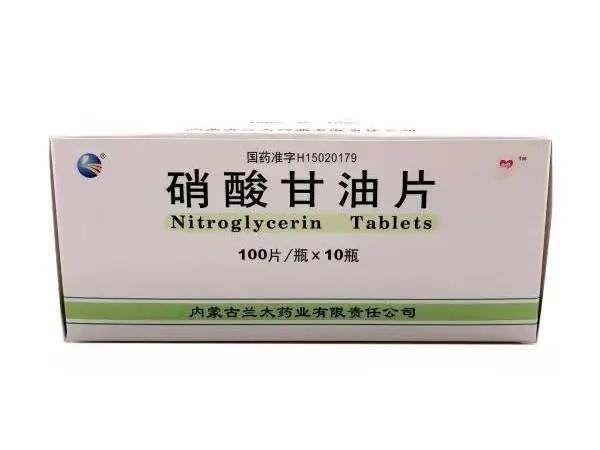
Function:
Treat angina pectoris. Injections are used to treat congestive heart failure.
Dosage:
Tablets for the treatment of acute angina pectoris: Adults take 0.25-0.5mg (half a tablet – 1 tablet) at a time, taken sublingually. Repeat 1 tablet every 5 minutes until pain is relieved. If pain persists after a total of 3 tablets within 15 minutes, seek medical attention immediately. Sublingual tablet: One tablet should be taken under the tongue or on the buccal mucosa of the mouth. Repeat every 5 minutes until symptoms subside. If chest pain is not relieved after taking 3 tablets within 15 minutes or if the pain becomes worse than before, other medical measures should be taken immediately. Aerosol/Spray: Spray 1-2 puffs on the sublingual mucosa of the oral cavity, equivalent to 0.5-1 mg of nitroglycerin. When using, remove the cap, shake well, aim the nozzle at the sublingual mucosa of the oral cavity, press the valve, and the medicinal solution will be sprayed into the mouth in the form of mist. If the effect is not good, repeat the same dose after 10 minutes. To prevent angina pectoris attacks, it should be used prophylactically 5-10 minutes before engaging in activities or defecation that may cause angina pectoris attacks; ① Tablets/sublingual tablets: taken sublingually; ② Aerosols/sprays: administered to the oral sublingual mucosa Squirt 1-2 presses. Nitroglycerin injection used to lower blood pressure or treat heart failure is diluted with 5% glucose injection or sodium chloride injection and then infused intravenously. The starting dose is 5 μg/min. It is best to use an infusion pump for constant speed infusion. It can be increased by 5 μg/min every 3-5 minutes. If it is ineffective at 20 μg/min, it can be increased by 10 μg/min, and later it can be 20 μg/min. Individual differences in nitroglycerin vary widely among patients, and there is no fixed appropriate dose for intravenous infusion. The administration speed and dose should be adjusted according to individual blood pressure, heart rate, and other hemodynamic parameters. Nitroglycerin sodium chloride injection is used to control high blood pressure or maintain hypotension during surgery. The initial recommended dose is 25 μg/min, which can be increased by 25 μg/min every 5 minutes until the blood pressure stabilizes, usually 10-200 μg/min. Yes, although in some cases during surgery the dose may need to be increased to 400 μg/min. The starting dose for the treatment of myocardial ischemia before surgery is 15-20 μg/min, and the dose can be increased by 10-150 μg/min until the desired effect is achieved. For latent congestive heart failure, the recommended initial dose is 20-25 μg/min, which can be reduced to 10 μg/min, or increased by 20-25 μg/min every 15-30 minutes until the desired effect is achieved. For unstable angina pectoris, the initial recommended dose is 10 μg/min, and the dose can be increased at a rate of 10 μg/min every 30 minutes according to the patient’s needs. After preparation, the drug is stable in the recommended container at room temperature for approximately 24 hours. Medication should be used immediately once opened. Do not use any discarded medication. Nitroglycerin Injection/Nitroglycerin Sodium Chloride Injection should not be mixed with other drugs. Nitroglycerin patches are used for the long-term treatment of coronary heart disease, prevention of angina pectoris attacks, and treatment of chronic heart failure in combination with digitalis and/or diuretics. At the beginning, use 1 tablet daily and stick it on the chest skin. The dosage can be increased as needed. When using nitroglycerin transdermal patches, it is best to affix the patch to an area with less hair (such as the trunk or upper arms) at a fixed time every day. The patch should be removed after 10-14 hours to avoid the development of drug resistance. When using new tablets, remember to tear off the old tablets. The torn off old tablets are still effective, so please discard them immediately to prevent children from accidentally touching them. To avoid irritation, it should be applied to different parts each time, but not to wounds. Nitroglycerin tablets/sublingual tablets When using this form of nitroglycerin, the tablets should be placed under the tongue or sucked on the buccal mucosa of the mouth. Do not chew, crush or swallow. Nitroglycerin tablets/sublingual tablets should be stored in the original bottle, and the cap must be tightly closed after each dose to avoid loss of efficacy. When using nitroglycerin spray (nitroglycerin aerosol), remove the cap, shake well, and point the nozzle upward; aim the nozzle at the sublingual mucosa of the oral cavity, press the valve, and the liquid will be sprayed into the mouth in the form of mist. Remember to spray the liquid directly onto the sublingual mucosa and do not swallow it with saliva. When using it for the first time or leaving it for more than a week before using it again, you should test spray into the air first. If it fails to spray, please confirm whether it is used correctly or check whether the spray hole is blocked. The device of nitroglycerin aerosol/spray is a pressurized container. This type of container is strictly prohibited from being heated, hit, or punctured on the bottle, even if the medicine is used up. The above situations should be avoided.
Adverse reactions:
Cardiovascular system: Hypotension is common, and serious adverse reactions include severe hypotension and tachycardia. Skin: Facial flushing is common, and severe cases may lead to allergic reactions. Nerve: Common symptoms include dizziness (5%), headache (63%~64%), dizziness (6%), etc. In severe cases, persistent headache may occur. Blood: Serious adverse reactions include methemoglobinemia. If any of the above adverse reactions occur, please inform your doctor or pharmacist in time so that the doctor can determine the extent of the side effects and take necessary measures.
Drug contraindications:
If you are allergic to this product, please do not use it during breastfeeding.


Let us work together to protect precious health